
The Salamanders That Steal Their Neighbours' DNA
Category: The Animal Kingdom 29th July 2026
Sometimes evolution takes a dislike to paperwork and decides to subcontract reproduction. Meet the unisexual Ambystoma complex: all-female salamanders in North America that reproduce by a process called kleptogenesis. They do not pair off in matrimonial bliss. Instead they invite a local male of a related species over, use his sperm simply to kickstart the egg, and then - on some occasions and with maddening unpredictability - fold his DNA into the offspring. It is like borrowing a cup of sugar and coming back with a blender, a casserole and a photograph of his aunt.
Biologists call the trick kleptogenesis because 'steal the genome' sounded melodramatic enough without my help. The result is experimental genetics on a suburban scale: offspring may be diploid, triploid, even tetraploid, carrying genomic mosaics stitched from the maternal line and one or more paternal species (Ambystoma laterale, jeffersonianum and others). The lineages are remarkably old and resilient, possibly persisting for millions of years, which is both impressive and slightly rude to conventional notions of species.
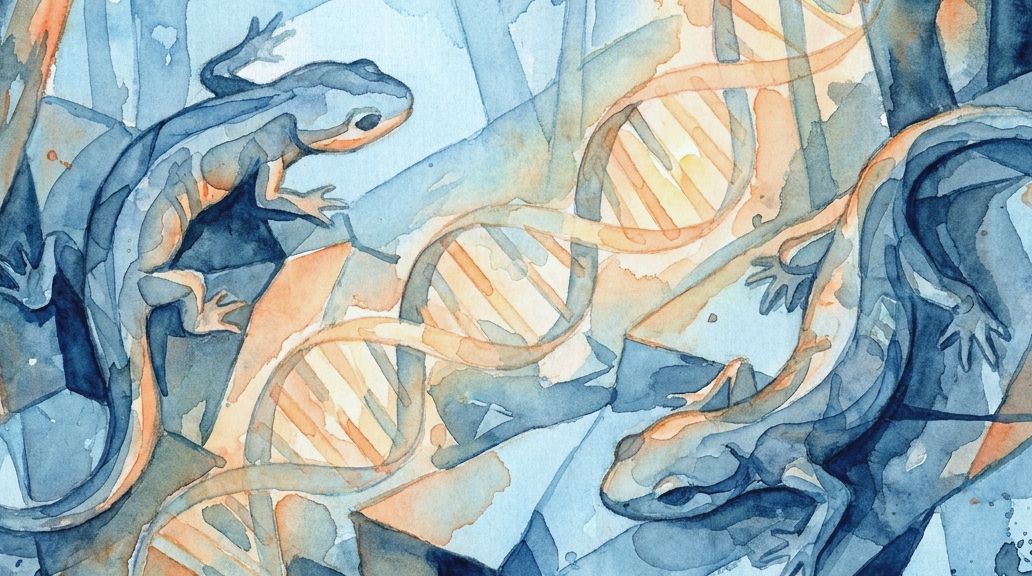
This behaviour politely demolishes the tidy boxes that taxonomists like to file things into. Are these salamanders a species, a hybrid swarm, a wallet of spare genomes or simply Nature's way of saying 'I will not be bureaucratised'? The answer is: yes. They depend on sexual males but are not enslaved by them; sometimes they simply use the sperm as an ignition key, sometimes they invite the genome to move in permanently, sometimes they decline and go their own parthenogenetic way. It is the amphibian equivalent of a civil servant who keeps a filing cabinet for three different ministries.
For anyone who enjoys small rebellions against tidy classification, the unisexual Ambystoma are a blessed nuisance. They are living proof that evolution is equal parts elegant logic and cheeky improvisation - and that nature, unlike a polite dinner guest, will help herself to the leftovers if they improve the gene pool.