
The Animal That's Actually a Team of Freeloaders
Category: The Animal Kingdom 5th July 2026
Consider a creature that looks like one organism but behaves like a small, miserable corporation where everyone has a job and nobody gets a pension. That is a siphonophore: technically one animal, practically a brigade of specialised units called zooids. They all come from one fertilised egg, are genetically identical, but each zooid does a single task and cannot survive on its own.
Yes, really. The Portuguese man o' war is the handiest example people have kicked sand at on beaches for years, but deep in the gloom live relatives such as Praya dubia that can stretch for forty metres or more. Imagine a living garden hose made of tiny squads: floats that keep it buoyant, nectophores that act like little swimming bells, gastrozooids that handle feeding, gonophores that sort reproduction and dactylozooids that are in charge of sticking you with painful little harpoons called nematocysts.
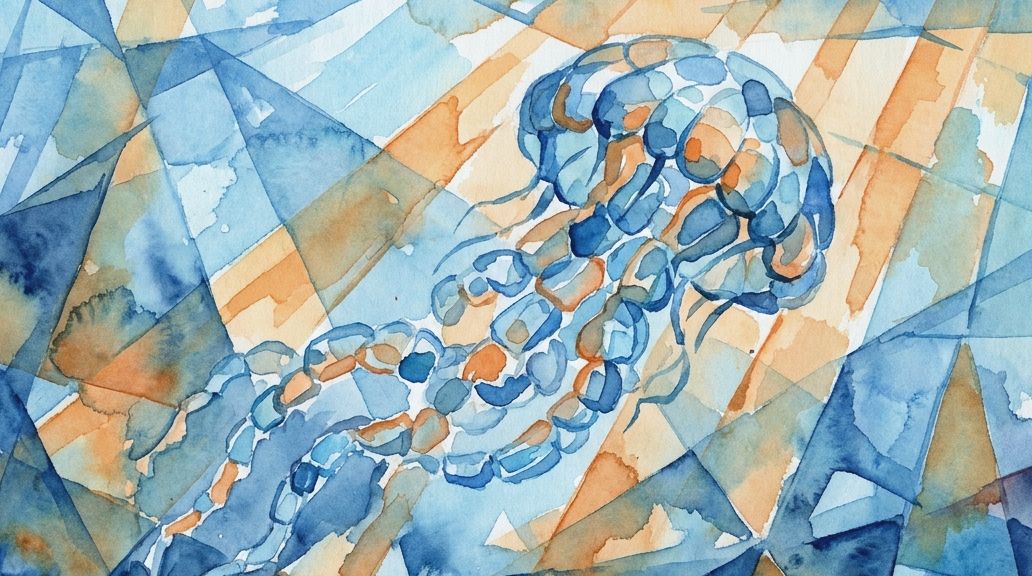
What makes siphonophores properly odd is the level of integration. Nutrients, signals and the odd burst of bioluminescence pass along a central stem so the whole colony acts like a single animal. Yet under the microscope it is a delegation meeting gone biological: one part hunts, another digests, another produces babies. No freelancing allowed. They are members of the Cnidaria, cousins of jellyfish and corals, but they turned cooperation into a survival strategy rather than a management buzzword.
Some live at the surface, some in crushing depths where bioluminescent displays look like tiny underwater discos. Their tentacles can deliver stings potent enough to ruin a day at the beach for humans, and scientists are still learning how these modular marvels coordinate complex behaviours without a central brain, only diffuse nerve nets and the chemistry of teamwork.
So next time you see a shimmering line or a trailing float, do not be fooled by the neatness. You are not looking at one animal. You are looking at a living conga line of tiny specialists doing what evolution asked for: be extremely good at one thing and live as part of the gang.