
They Almost Floated an Aircraft Carrier Made of Ice and I Love It
Category: Forgotten History 10th May 2026
Right in the middle of the Second World War someone in a planning room looked at the U-boat problem, shrugged, and said: "What if we built an aircraft carrier out of ice?" That someone was Geoffrey Pyke, and the idea was genuinely taken seriously. The material was called pykrete: roughly speaking, a mixture of water and wood pulp or sawdust that freezes into something far tougher and slower to melt than plain ice.
The purpose could not have been simpler or dafter in equal measure. The Atlantic needed forward airbases to hunt German submarines, and conventional carriers were scarce. The proposal was to build enormous, cheap floating platforms that could host planes and supplies-and because they were mostly frozen water, they would be hard to sink. Scientists, including Max Perutz, ran experiments on small blocks of pykrete. The stuff was strong, oddly resilient, and-crucially-melted very slowly compared with normal ice.
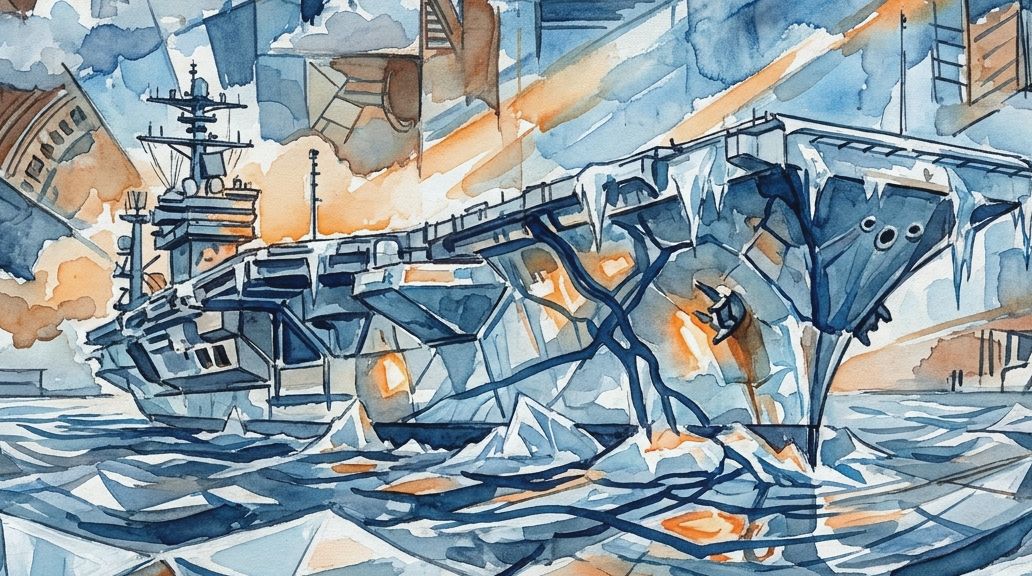
They even tested scale models and sketched grand plans for gargantuan carriers hundreds of metres long, insulated and refrigerated to keep them solid. The codename was Habakkuk. Imagine an iceberg with a runway; imagine Churchill being shown the drawings and trying very hard not to guffaw. The military liked the idea because it promised an essentially "unsinkable" base for anti-submarine aircraft in the mid-Atlantic where nothing else could loiter for long.
Why didn't the Royal Navy sail a frozen ark? Practicalities. Building, insulating and continuously refrigerating a floating continent is a logistical nightmare. Steel and concrete production, changing war priorities, and the sheer impracticality of operating such monstrosities when the Allies gained naval supremacy all nudged the project off the table. Habakkuk was shelved, and pykrete returned to the realm of brilliant wartime madness.
It remains one of history's loveliest lunacies: a serious plan to fight submarines with giant, man-made icebergs. If nothing else it proves that wartime creativity sometimes borders on the brilliant, and sometimes tilts straight into the splendidly absurd.