
Hyperion: The Moon That Won't Sit Still
Category: Outer Space 12th June 2026
Believe me, I have seen restless types - showgirls, heiresses, tabloid husbands - but nothing in my years of watching people wobble at last call prepared me for Hyperion. This is a moon that refuses to behave. It does not turn faithfully to Saturn like most moons; instead it tumbles, flips and spins in a way astronomers call chaotic rotation.
Hyperion looks like someone took a cratered sponge, left it out in the sun and forgot to be tidy. Its surface is a ridiculous patchwork of deep, sharp-edged craters and dark material, and the whole thing is worryingly fluffy: less dense than water, which means the rock is shockingly porous. Picture a celestial bagel with a lot of air inside and you are in the right neighbourhood.
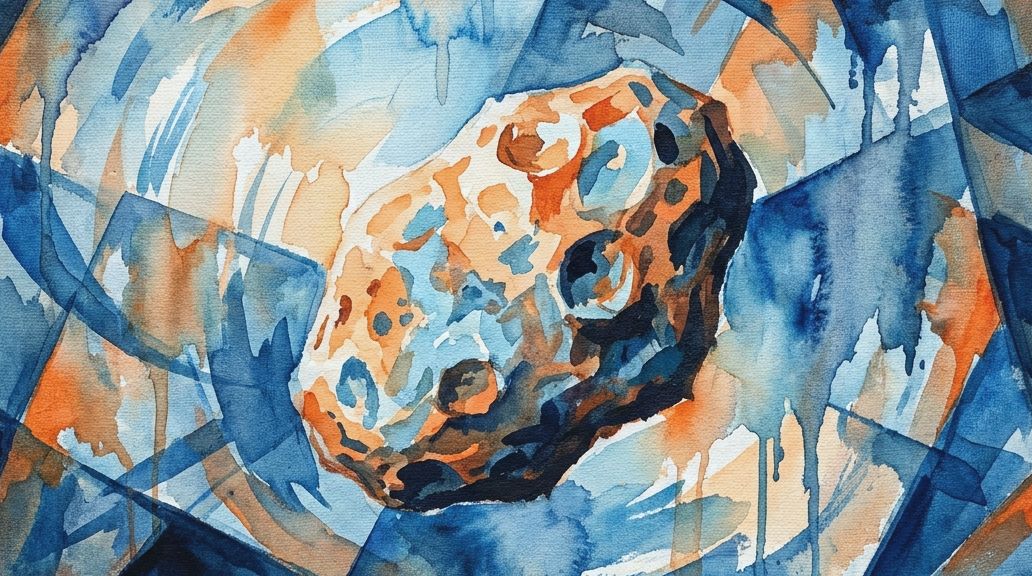
The reason it cannot keep a steady spin is deliciously simple and properly cosmic: shape, gravity and bad company. Hyperion is oddly shaped and irregular, so Saturn's pull does not torque it into a polite tidally locked pose the way it does our Moon. Add Titan into the mix - a big, bossy neighbour - and tiny gravitational nudges from Saturn's complex system send Hyperion into unpredictable rotational tantrums.
Astronomers first twigged to this behaviour when spacecraft and telescopes noticed that Hyperion's sunlight patterns could not be modelled by any steady rotation. Subsequent flybys confirmed the moon really does tumble in a chaotic fashion, its orientation at any future time effectively impossible to predict beyond short windows. It is one of the few natural satellites we know that behaves like this, and that is saying something in a Solar System full of oddballs.
It is tempting to anthropomorphize - call it moody, eccentric, noncommittal. I prefer the truth: Hyperion is a physics party trick, where geometry and gravity conspire to make a small world delightfully unruly. For a retired gossip, there is pure joy in watching the universe produce a star of chaos without a PR team.