
It Rains Glass on That One Exoplanet and Everyone's Very Calm About It
Category: Outer Space 31st May 2026
Recently astronomers peered at a world called HD 189733b and discovered a weather report that reads like a mad civil servant's resignation letter: silicate particles condense into tiny glass droplets and then, in a most undignified fashion, rain sideways. This is not quaint drizzle but molten sand forming microscopic beads that cool into glass and hurtle through the atmosphere on supersonic winds.
HD 189733b is a 'hot Jupiter'-a gas giant that sits so close to its star that one face is in perpetual noon and the other in perpetual dusk, like a guest at a dinner party who refuses to leave either the table or the conversation. Because it is tidally locked, the permanent day side broils; temperatures and chemistry allow silicate vapour to condense into glassy particles in the cooler regions, and then the planet's savage winds, moving at thousands of kilometres per hour, fling them across the sky.
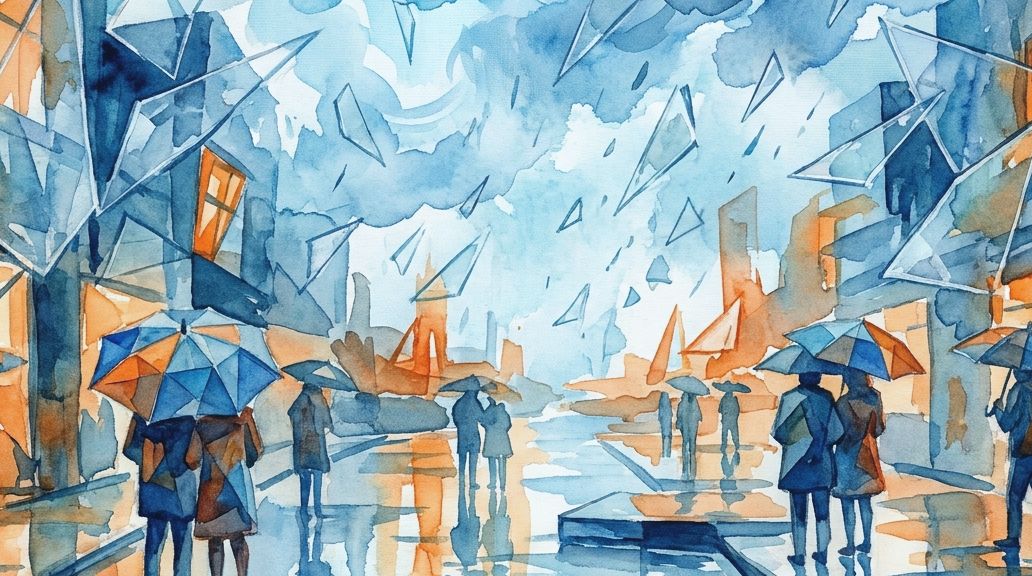
The planet's startling deep-blue tint, observed by space telescopes, is not charming oceanic poetry but the result of light scattering off these silicate particles-tiny shards of glass in an atmosphere with the manners of a street brawl. Imagine a seaside storm, only replace salt with sand melted into fine glitter and the sea with an atmosphere made of metal-rich vapour. Glasstoshery, if you will.
Scientists are reasonably polite about this: models and spectral observations suggest the condensation and transport of these particles is real. They call it exotic cloud chemistry and publish papers with sober figures, charts and the occasional phrase like 'violent supersonic transport' which reads like a recipe for an ill-advised opera.
As a performing fellow once caught in a Gloucestershire downpour of entirely ordinary rain, permit me the observation that umbrellas are rendered absurd on HD 189733b. An umbrella there would be an emblem of theatrical naivety-splintered, sideways, and full of glass. The planet does not care for human convenience. It prefers to be dramatic, furious, and scientifically fascinating all at once.