
The Coastline That Cheats Your Ruler
Category: Geography & Maps 7th June 2026
Once I tried to measure the shoreline of a beach on vacation like a responsible adult and it felt fraudulent. I walked a tape measure along wet sand, paused for a crab, scribbled a number into a notebook and then an old man with binoculars said, very calmly, "You used the wrong ruler." He was right and also somehow judging my life choices.
Here is the actual weirdness: a coastline does not have one single length. The smaller the unit you use to trace every jag, inlet and cliff nick, the longer the coastline gets. Chop your ruler in half, and you pick up more twists. Chop it again, and suddenly a bay has branches you did not know existed and your neat little number swells. It is not a mistake, it is geometry being performative.
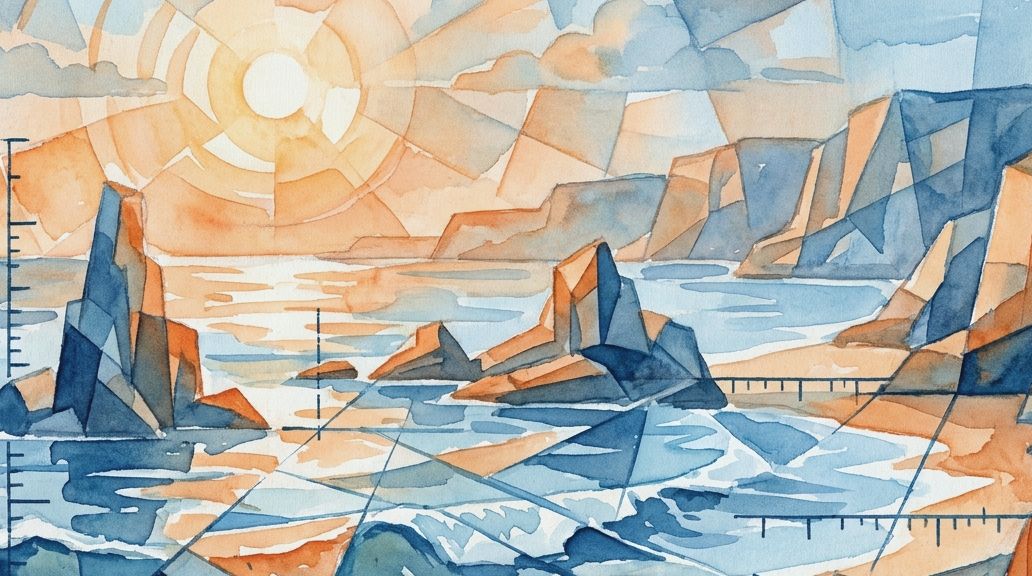
This is called the coastline paradox. Lewis Fry Richardson noticed the measurement dependence early on and Benoit Mandelbrot later gave it its swagger by pointing out how coasts behave a bit like fractals: patterns that repeat at different scales. In plain terms, the map you see is a polite compromise between detail and patience. Zoom in forever and a coastline can keep revealing detail in a way that makes the idea of a single finite length feel like a bedtime lie.
Real cartographers and geographers have to choose a scale, because maps are tools, not universal truths. That is why published lengths for countries wobble depending on who did the math and what measuring stick they preferred. Norway's fjords will make your length-sense dizzy. Britain was the poster child in popular accounts because its jagged edges look very dramatic under a microscope of measurement.
I like to think of it as emotional cartography: relationships, pride, my attention span. You try to measure something intimate with a yardstick and it refuses to be neat. The coastline paradox is a polite reminder that the world resists being simplified into one tidy statistic, and sometimes the more you try to pin it down, the more it proves how gloriously messy everything really is.