
Why An Armadillo Will Never Be A Unique Snowflake
Category: The Animal Kingdom 13th July 2026
Naturally, one expects beasts to be pleasantly individual: a fox with its own misdemeanours, a badger with manners, a hedgehog with a private grumble. The nine-banded armadillo declines this social contract. When a female of the species gives birth she does not serve up a charming variety pack; she hands you four indistinguishable carbon copies. Four. Identical. Quadruplets.
Scientifically speaking the trick is called monozygotic polyembryony: a single fertilised egg splits into multiple embryos so that all offspring share the same genome. It is a feature of the genus Dasypus and is irritatingly reliable. Where most mammals produce genetically distinct siblings, this particular armadillo population produces a tidy set of replicas - as if evolution had access to a bulk-buy photocopier and an eye for efficiency.
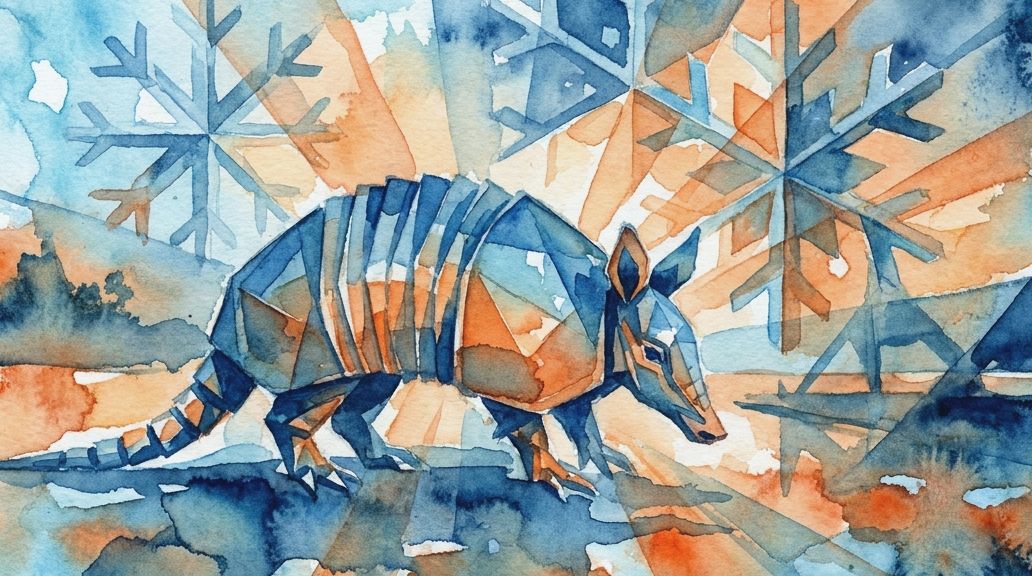
The result is deliciously inconvenient for anyone who studies population genetics. Littermates are perfect genetic controls; for researchers this has practical value because comparing behaviour or disease outcomes between genetically identical siblings removes a whole hedgehog's worth of confounding variables. For the rest of us, it means nature sometimes favours cloning as a strategy, and then looks at us with the mild exasperation of a civil servant who has just completed the same form four times.
This reproductive quirk is not a comic invention. You can confirm it in field guides, zoological accounts, and the patient entries of mammal specialists. It also has the charming consequence that a mother might rear four near-perfect copies of the same escape-plan, the same temperament and the same awkward relationship with garden hoses. Imagine a litter of armadillos texting each other identical grumbles about the compost bin; frankly, I have seen less symmetry in a military parade.
In short: the nine-banded armadillo takes sibling rivalry off the table and replaces it with a small, burrowing regiment of clones. It is odd, tidy, and slightly bureaucratic - precisely the sort of natural eccentricity that makes me feel better about my own chaotic family tree.